
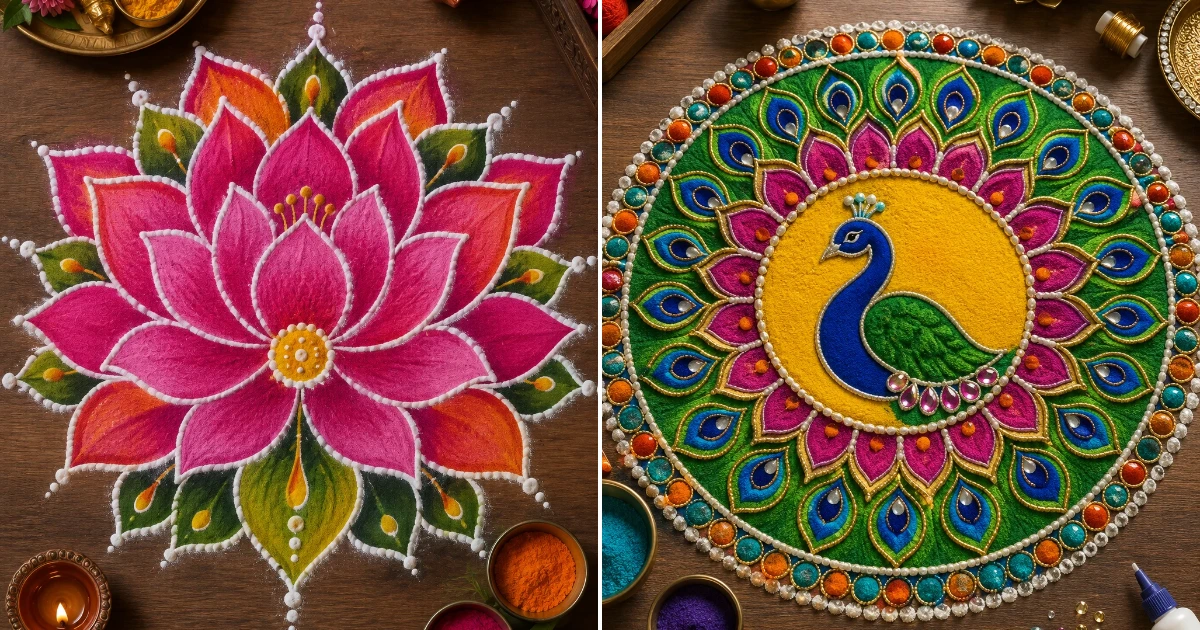
indian rangoli designs are decorative floor-art patterns made with colored powders, rice, flowers, sand, or other materials to brighten entrances, courtyards, and festive spaces. If you think rangoli requires a ruler, a math degree, and the patience of a saint, good news: it doesn’t. According to The Spruce Crafts,These colorful designs can be surprisingly approachable, even when your freehand skills are more “creative adventure” than “perfect symmetry.”
From tiny daily patterns to dramatic Diwali centerpieces, there is a design for every skill level. The ideas below mix traditional Indian rangoli art with practical techniques, including dots, flowers, geometric shapes, peacocks, diyas, and lotus motifs. According to Martha Stewart Crafts,Pick your favorite colors, clear a little floor space, and prepare for the inevitable moment when someone says, “Can you make one for my house too?”
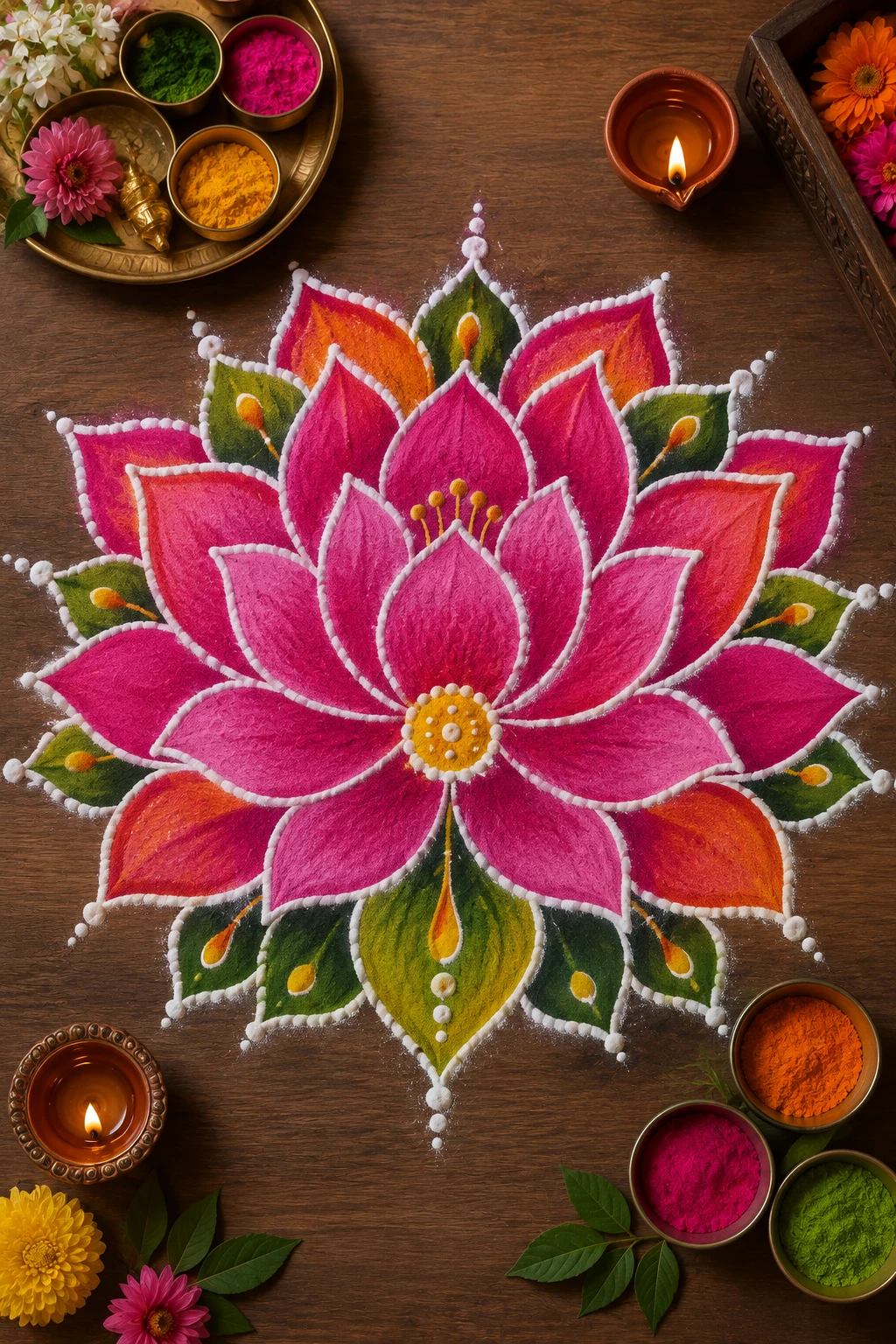
1. Classic Lotus Glow — Indian Rangoli Designs With Colours
The lotus is one of the easiest motifs to recognize and one of the most satisfying to draw. Start with a small yellow or orange center, then build eight to twelve rounded petals around it. Fill the petals with pink, coral, magenta, or red powder and outline them with white for definition.
For rangoli powder, use a fine-grain texture so the petals have smooth edges. A small spoon or paper cone can help you control narrow outlines, while your fingertips are perfect for gently shaping larger areas.
The key to this look is layering the lotus petals from the center outward so the design stays balanced rather than becoming a floral free-for-all.
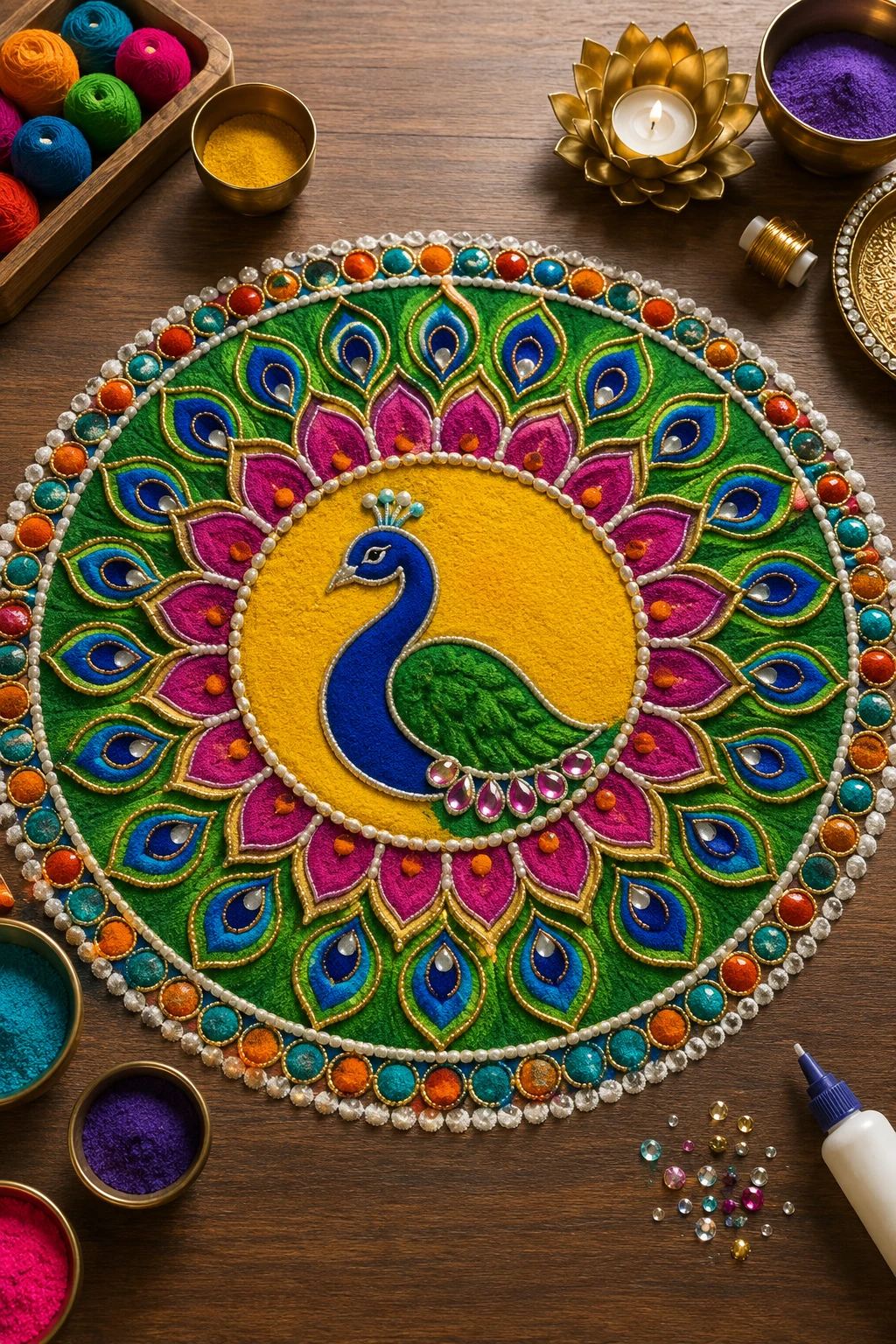
2. Peacock Jewel Circle — indian
Peacock motifs bring serious drama to indian rangoli designs without requiring dozens of complicated elements. Draw a curved blue or teal body in the center, then surround it with emerald-green feathers decorated with turquoise, purple, yellow, and white details.
Use colored rangoli powder for the broad feather shapes and a fine white powder line to separate individual feathers. For a richer festive finish, place tiny flower petals or colored rice along the outer circle.
The key to this look is using contrasting jewel tones such as cobalt blue, emerald green, fuchsia, and gold-yellow to make the peacock instantly recognizable.
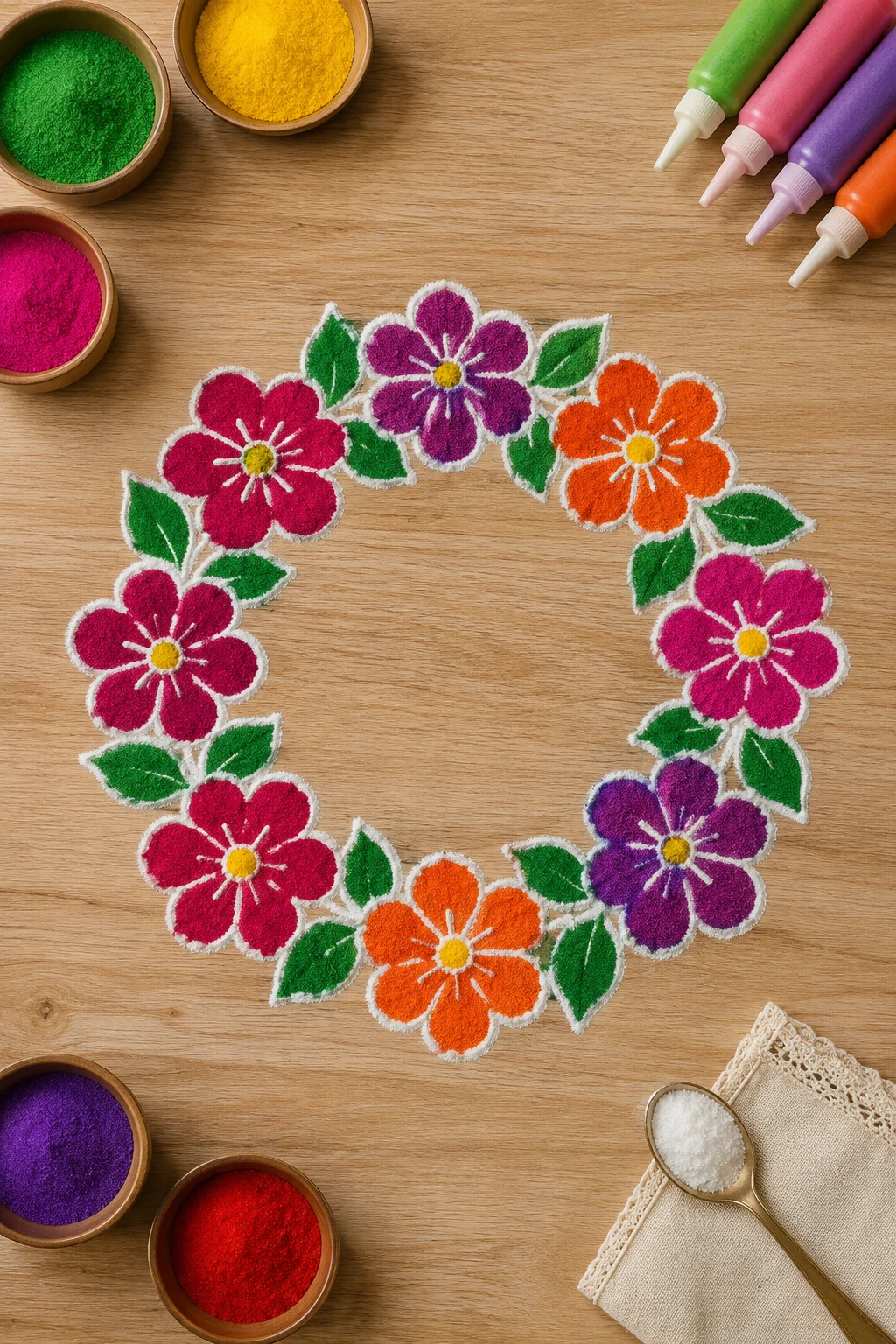
3. Simple Freehand Flower Ring — indian
Want indian rangoli designs simple enough for a weekday morning? Try a flower ring. Draw a central circle and surround it with evenly spaced six-petal flowers. Alternate pink and orange blossoms, then add green leaves between them.
This design works particularly well when you are learning freehand control because mistakes can hide naturally inside the petals. White rangoli powder is useful for outlines, while yellow makes cheerful flower centers.
The key to this technique is repeating one small flower shape consistently instead of trying to make every petal different.
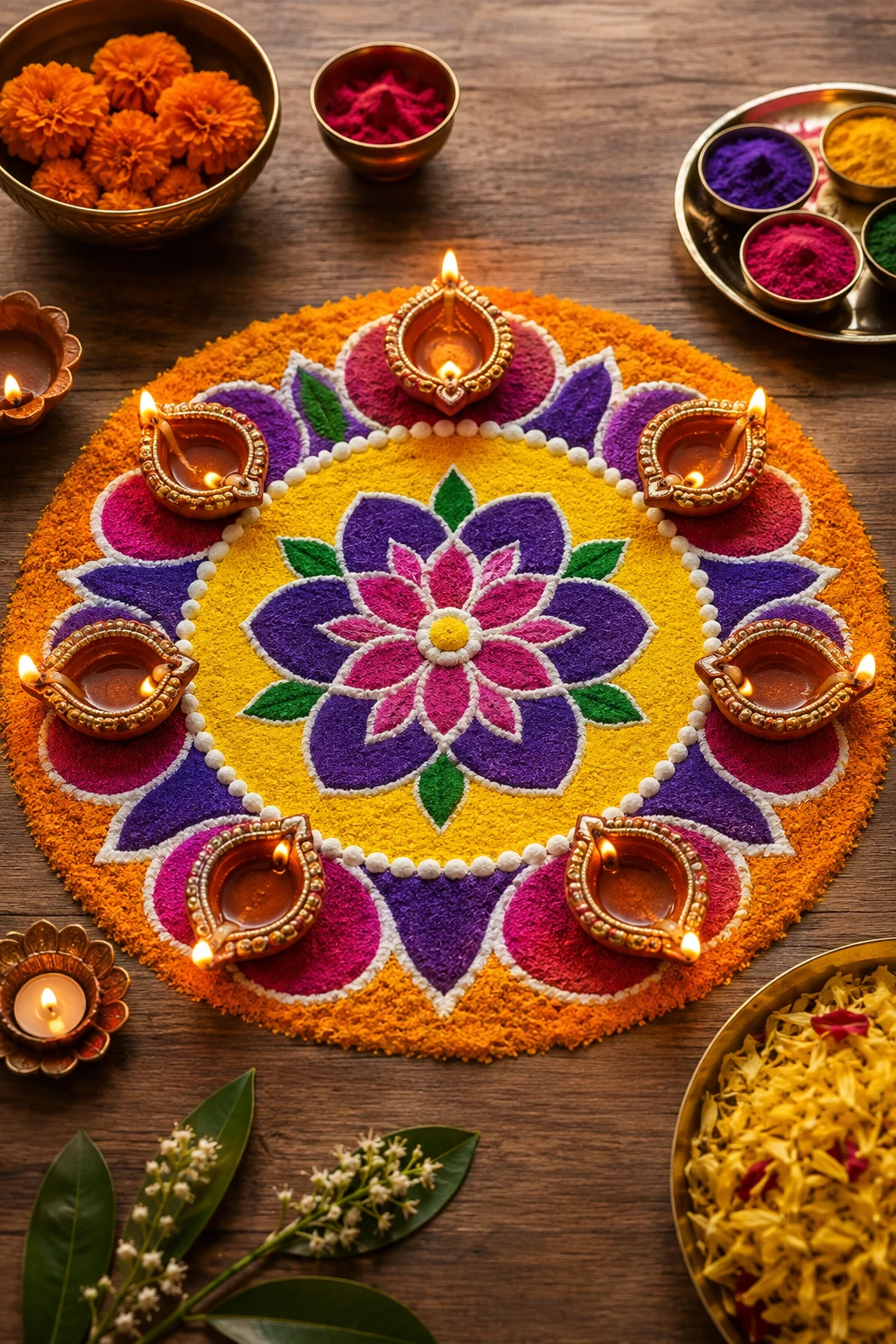
4. Diwali Diya Circle — Indian Rangoli Designs for Diwali
A Diwali rangoli practically begs for diyas. Create a circular pattern with four or eight diya shapes pointing outward, then fill each lamp with orange, red, and yellow. Connect the lamps with vines, dots, or tiny flowers.
Place real clay diyas around the finished design rather than directly on delicate powder sections. During Diwali, warm candlelight can make orange and red rangoli colors appear especially vibrant.
The key to this look is repeating the diya motif around a central circle so the composition feels festive and symmetrical.
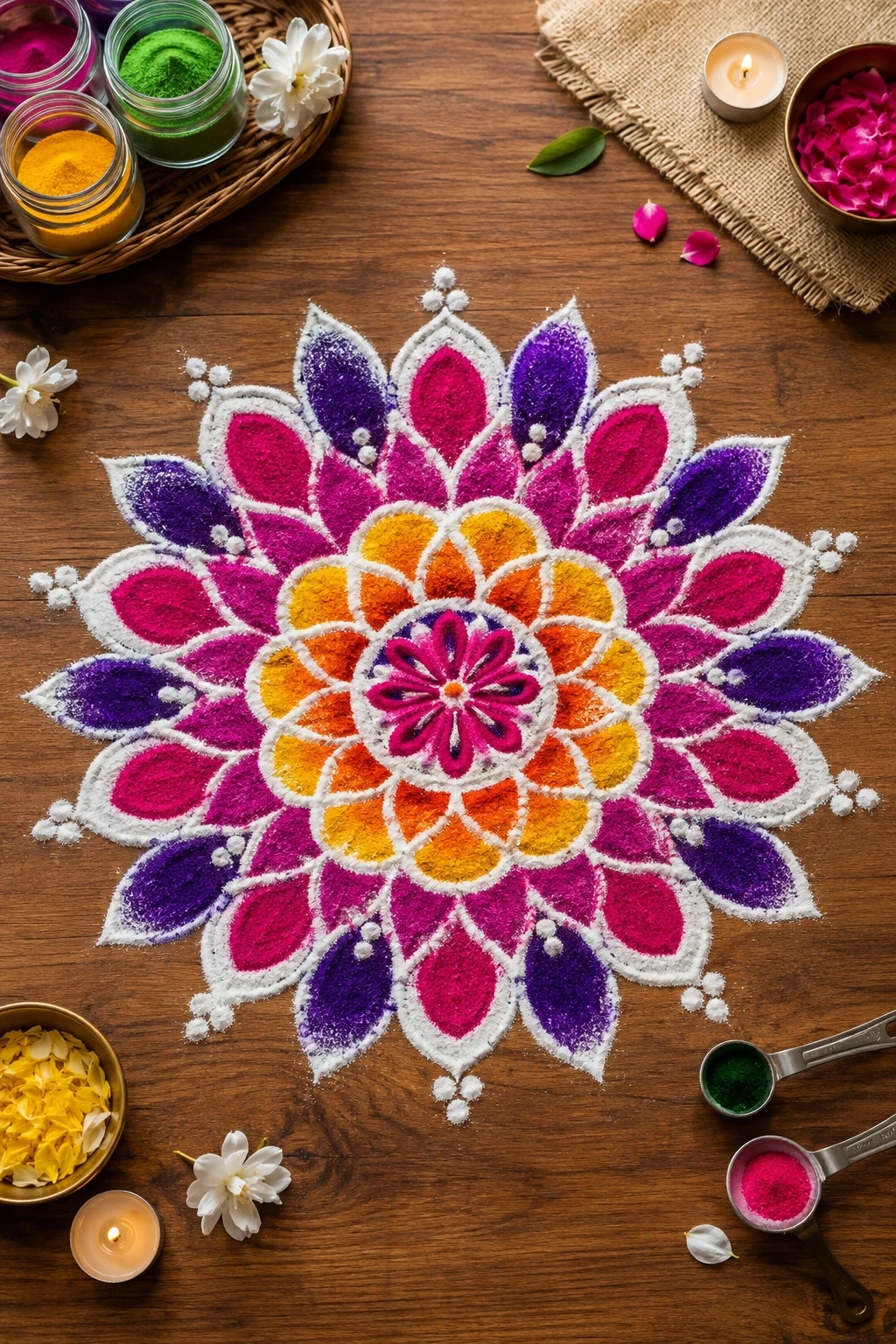
5. Floral Petal Mandala
A floral mandala is ideal when you want indian rangoli designs with colours that feel detailed without becoming overwhelmingly complicated. Begin with a small central dot, add a ring of petals, then continue outward with alternating scallops, leaves, and dots.
Try a palette of marigold orange, royal blue, raspberry pink, leafy green, and white. Rangoli stencils can help establish the outer geometry, while the interior details can remain freehand.
The key to this look is building several concentric layers, with each layer slightly larger than the one before it.
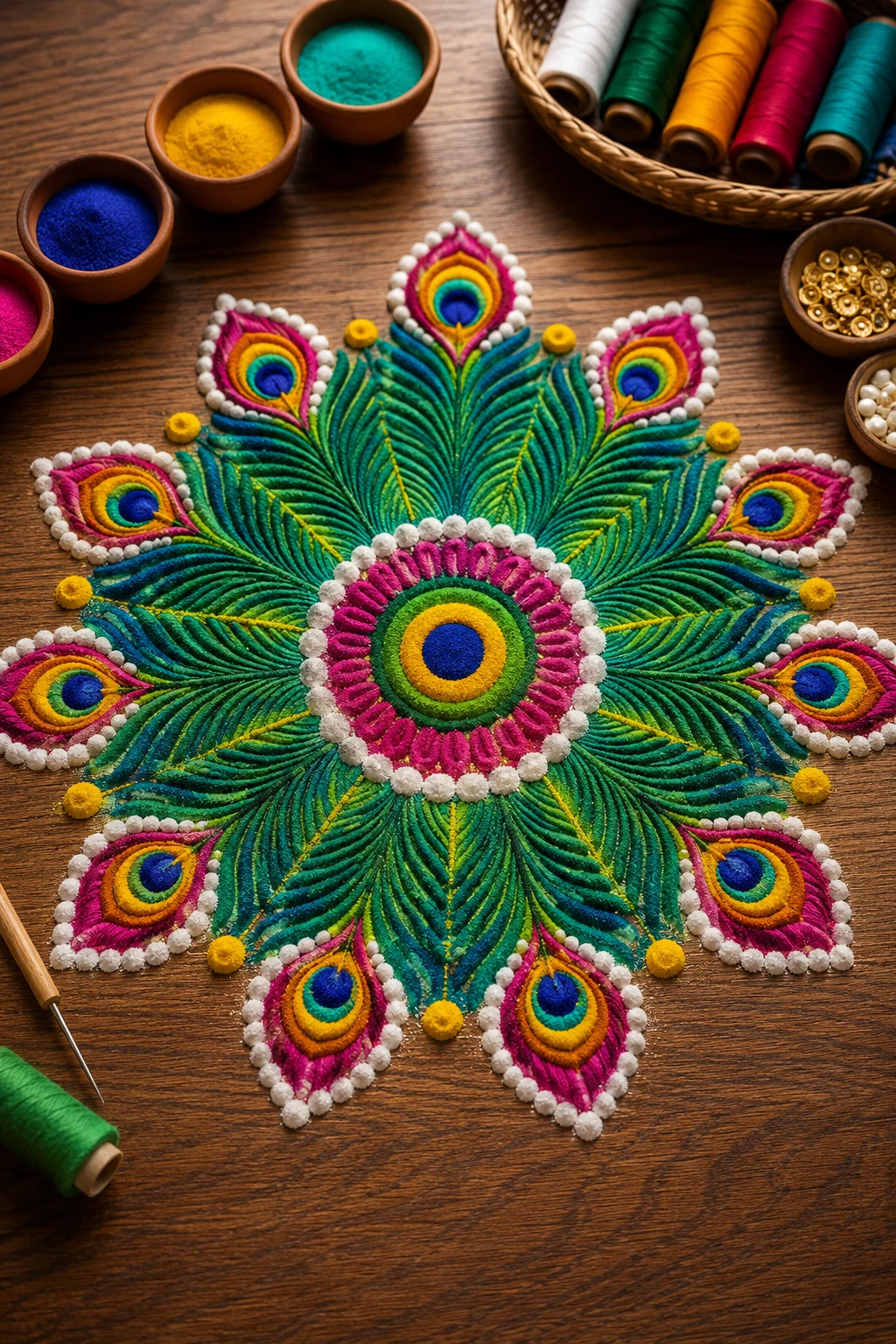
6. Peacock Feather Burst
Instead of drawing an entire peacock, focus on its most recognizable feature: the feather. Create a central circular eye motif using navy, turquoise, green, yellow, and white, then repeat it around a large sunburst.
This approach is especially useful for beginners searching for an indian rangoli drawing that looks elaborate but relies on one repeated shape. Use fine-tip powder applicators for the feather outlines.
The key to this look is repetition—one well-designed feather becomes a spectacular pattern when multiplied around the center.
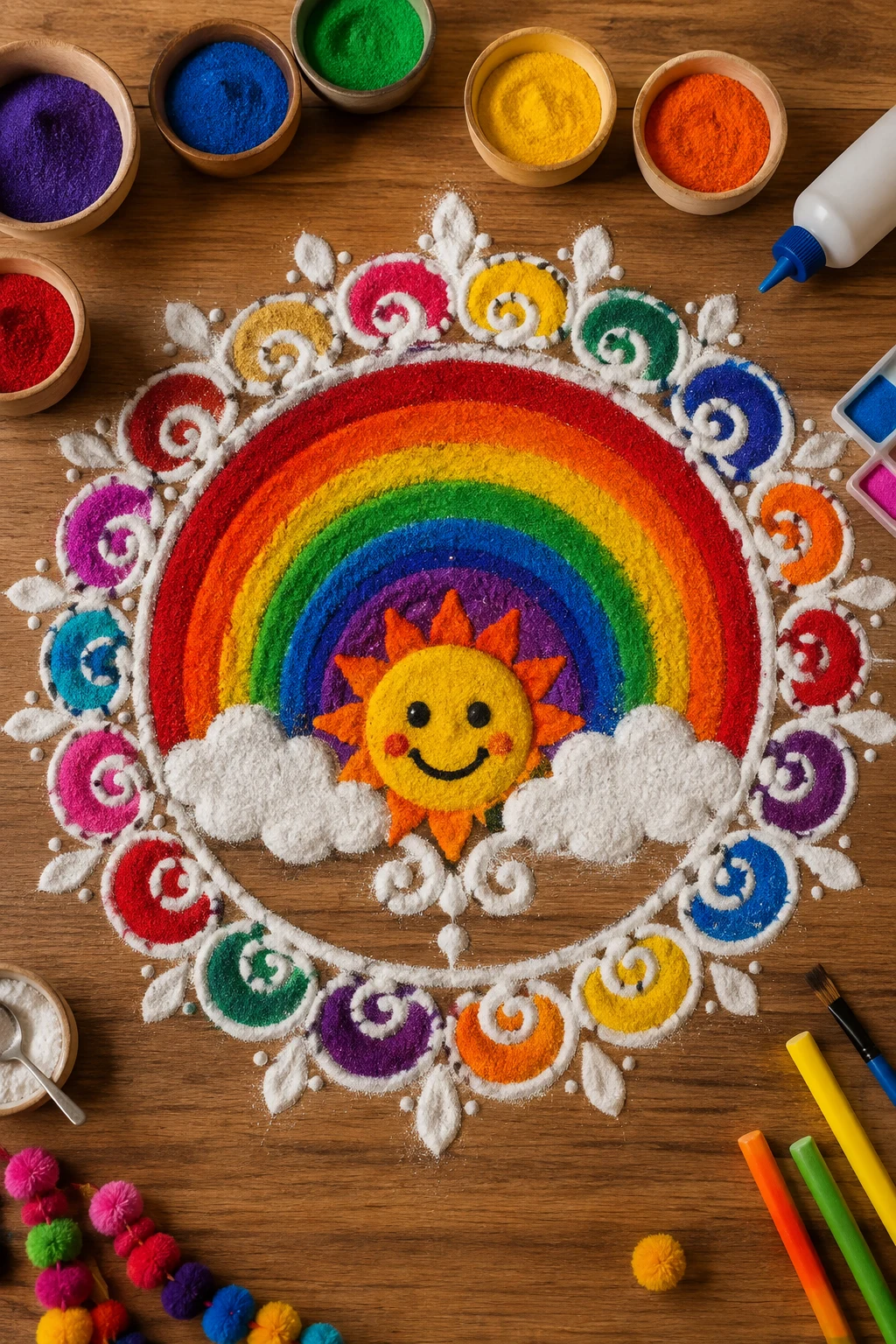
7. Kids’ Rainbow Rangoli
Indian rangoli designs for kids should be fun rather than painfully precise. Draw large flowers, hearts, circles, stars, or simple spirals and let children fill each section with bright colors such as pink, purple, yellow, green, and blue.
Use non-toxic rangoli powders and create the design on cardboard, a washable mat, or another supervised surface if indoor cleanup is a concern. Dot-based patterns are particularly beginner-friendly because children can connect or decorate the dots without worrying about perfect lines.
The key to this technique is large, simple shapes with plenty of room for colorful filling.
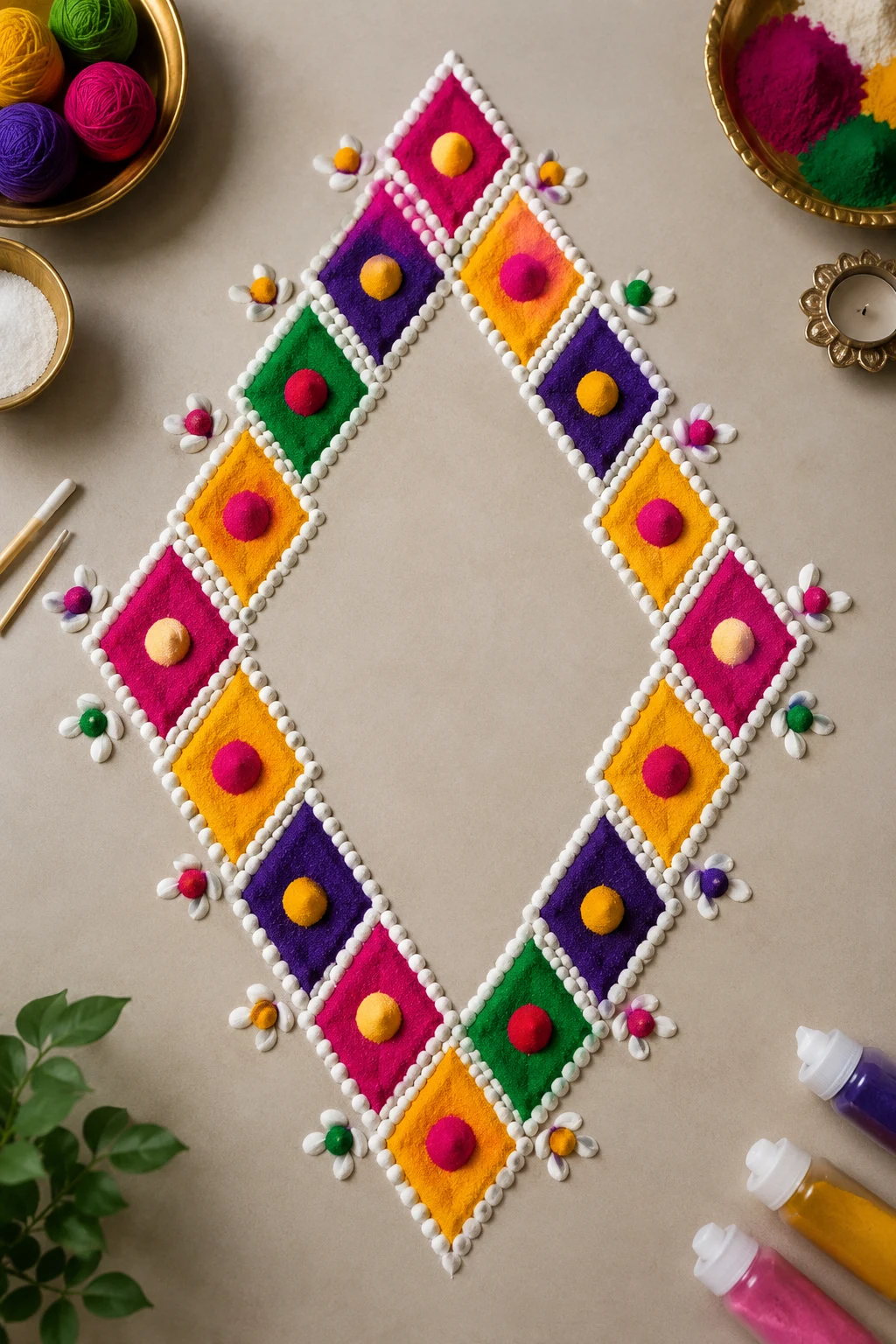
8. Geometric Diamond Border
For a more structured design, build a border from repeating diamonds. Draw a square or circular outline first, divide the perimeter into sections, and fill each section with alternating diamond shapes.
Red and white create a classic contrast, while teal and yellow give the pattern a contemporary feel. White chalk can be useful for lightly marking the layout before adding permanent powder.
The key to this look is keeping the spacing between diamonds consistent, which makes the entire border appear professionally planned.
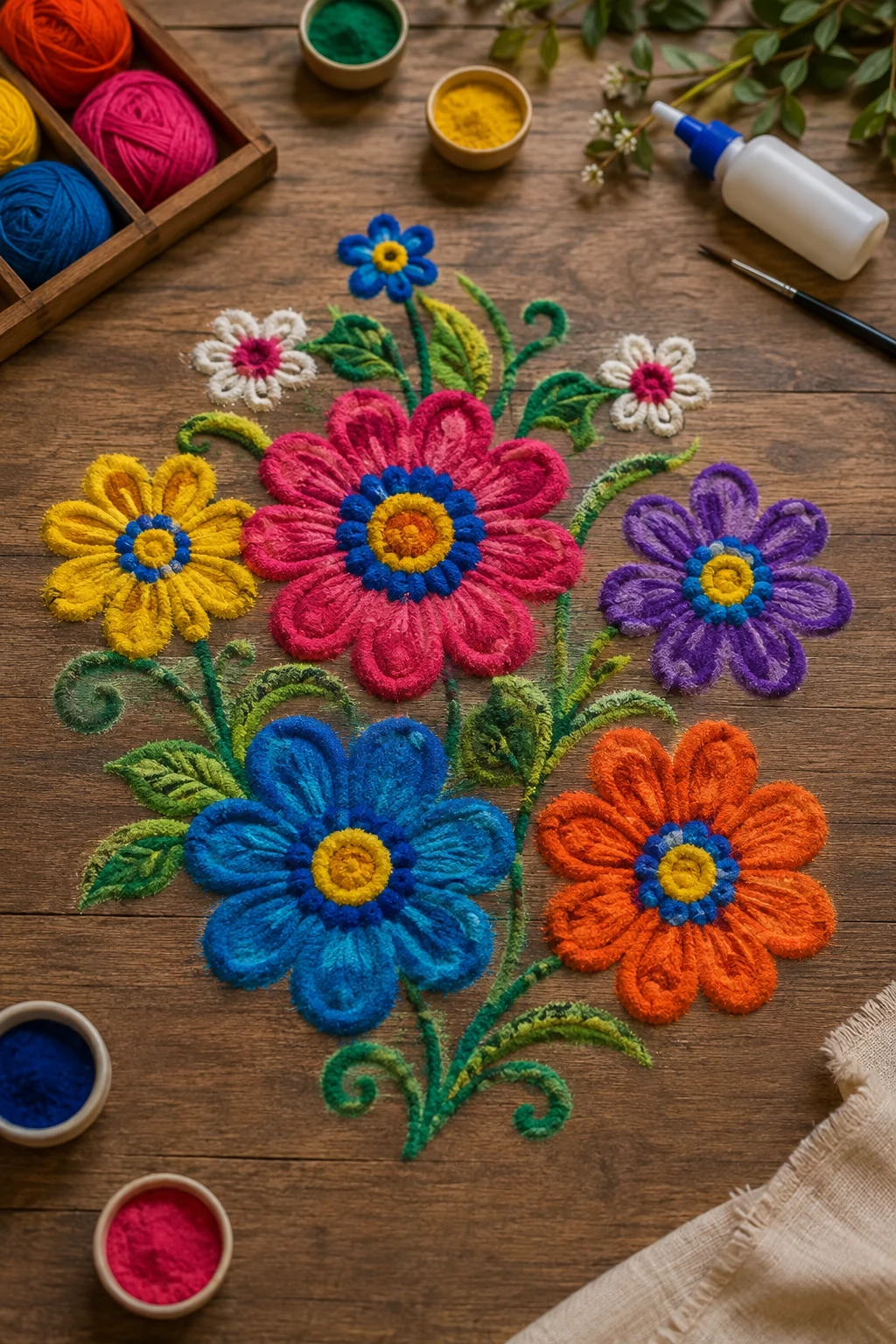
9. Freehand Flower Garden
Free hand flower rangoli ideas work beautifully when you want a design that feels organic. Instead of forcing perfect symmetry, draw different flowers around a central area and connect them with curling stems and leaves.
Combine lotus petals with small daisies, marigold-inspired blossoms, and simple five-petal flowers. Flower petals can be mixed with rangoli powder for texture, particularly around entrances during festivals.
The key to this look is varying flower sizes while repeating a limited color palette so the design still feels cohesive.
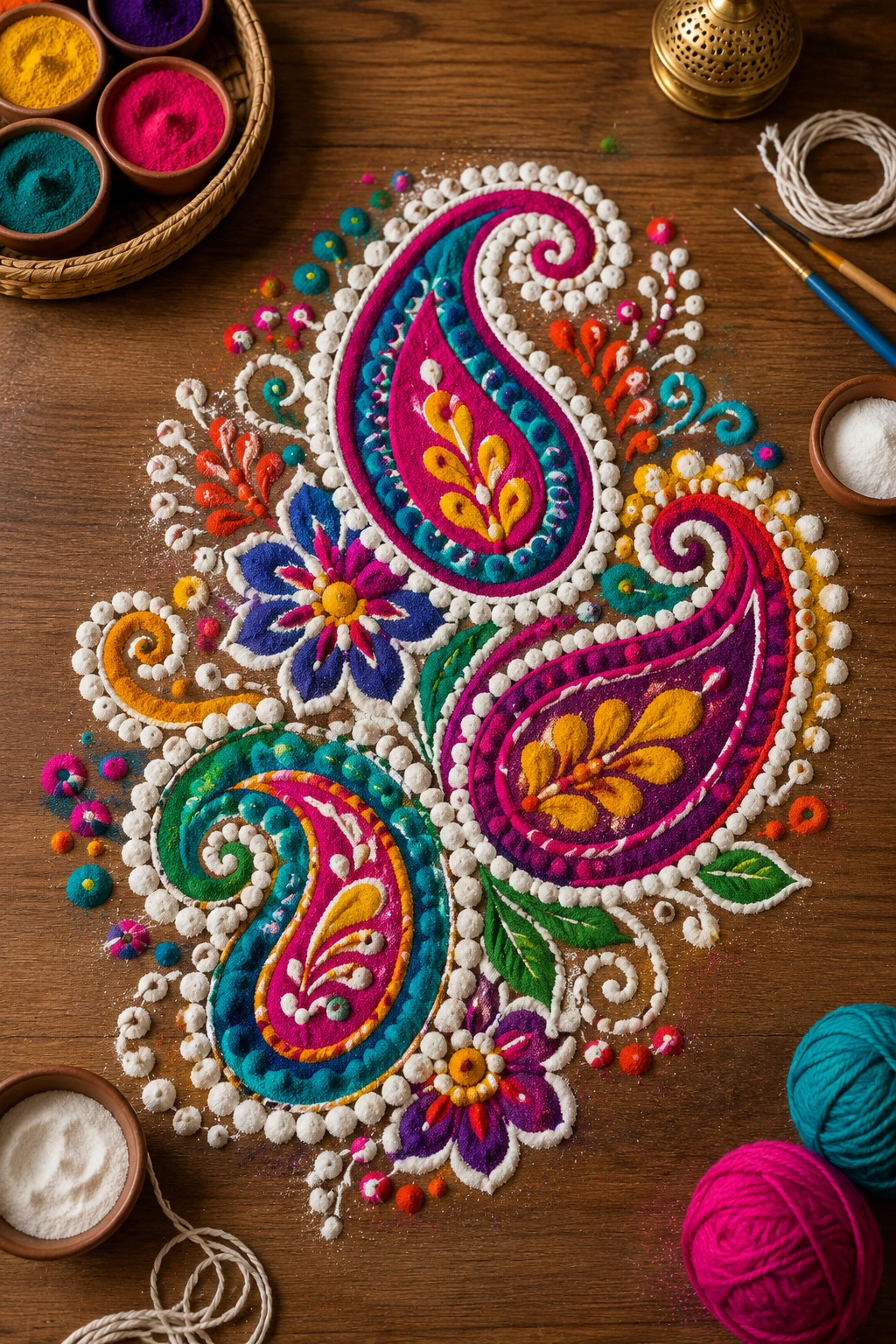
10. Paisley Party
Paisley shapes are excellent for filling awkward spaces because their curved silhouettes naturally flow into one another. Start with one large paisley, decorate it with smaller leaves and dots, then mirror or rotate the shape around the center.
Try crimson, mustard yellow, deep green, and white for a traditional palette, or switch to coral, lavender, turquoise, and navy for something more playful. Fine rangoli powder makes it easier to draw the narrow paisley curls.
The key to this technique is drawing the outer paisley curve first and adding interior details afterward.
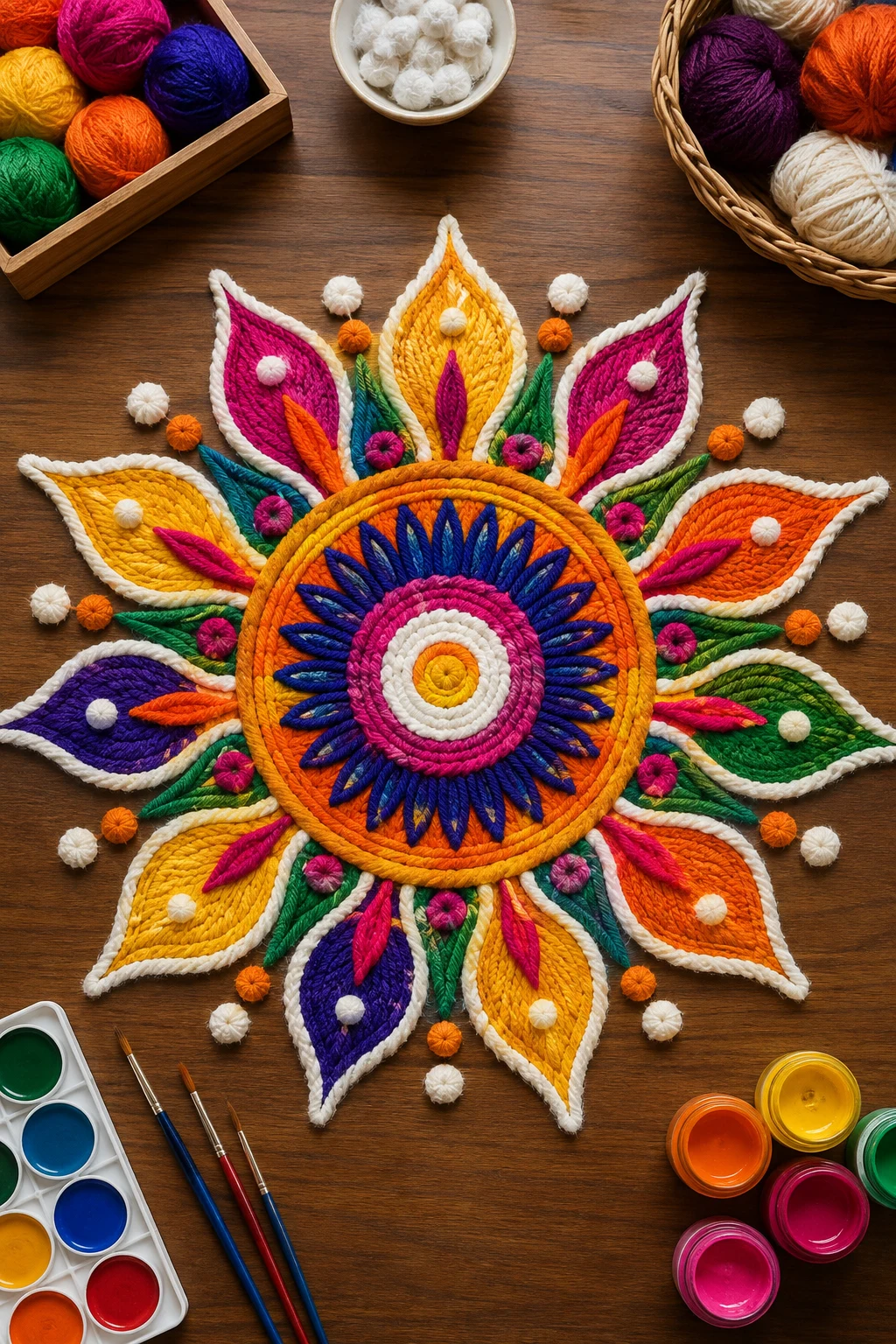
11. Rangoli Sunburst
A sunburst is one of the best indian rangoli designs simple with colours because the entire composition revolves around one easy idea: rays spreading outward from the center. Draw a central circle, then add triangular, petal-like, or curved rays.
Use yellow and orange in the middle, followed by pink, red, and purple toward the edges. Add tiny white dots between rays to sharpen the pattern.
The key to this look is alternating long and short rays to create movement without making the design too complicated.
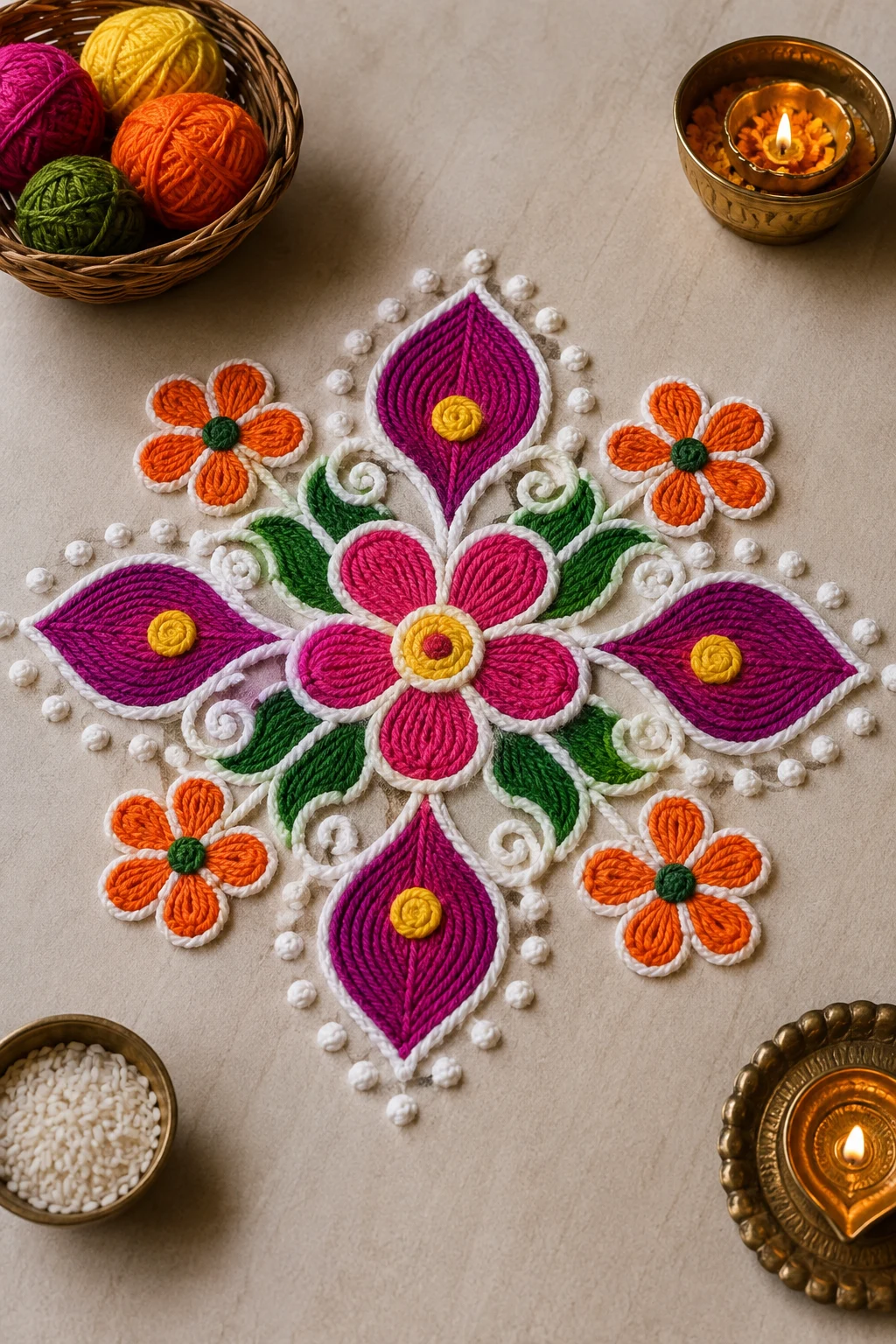
12. Everyday Dot-and-Flower Rangoli — Indian Rangoli Designs With Dots
Indian rangoli designs with dots are especially useful for practicing symmetry. Arrange a grid of dots, then connect them with curved lines, petals, loops, and small leaves. Once the structure is complete, fill selected spaces with color.
This technique connects naturally with Indian kolam designs, where dots can guide intricate looping patterns. Start with a small grid for everyday decoration and gradually increase the number of dots as your confidence grows.
The key to this look is using the dots as your invisible framework, allowing the finished design to appear freehand while staying remarkably balanced.
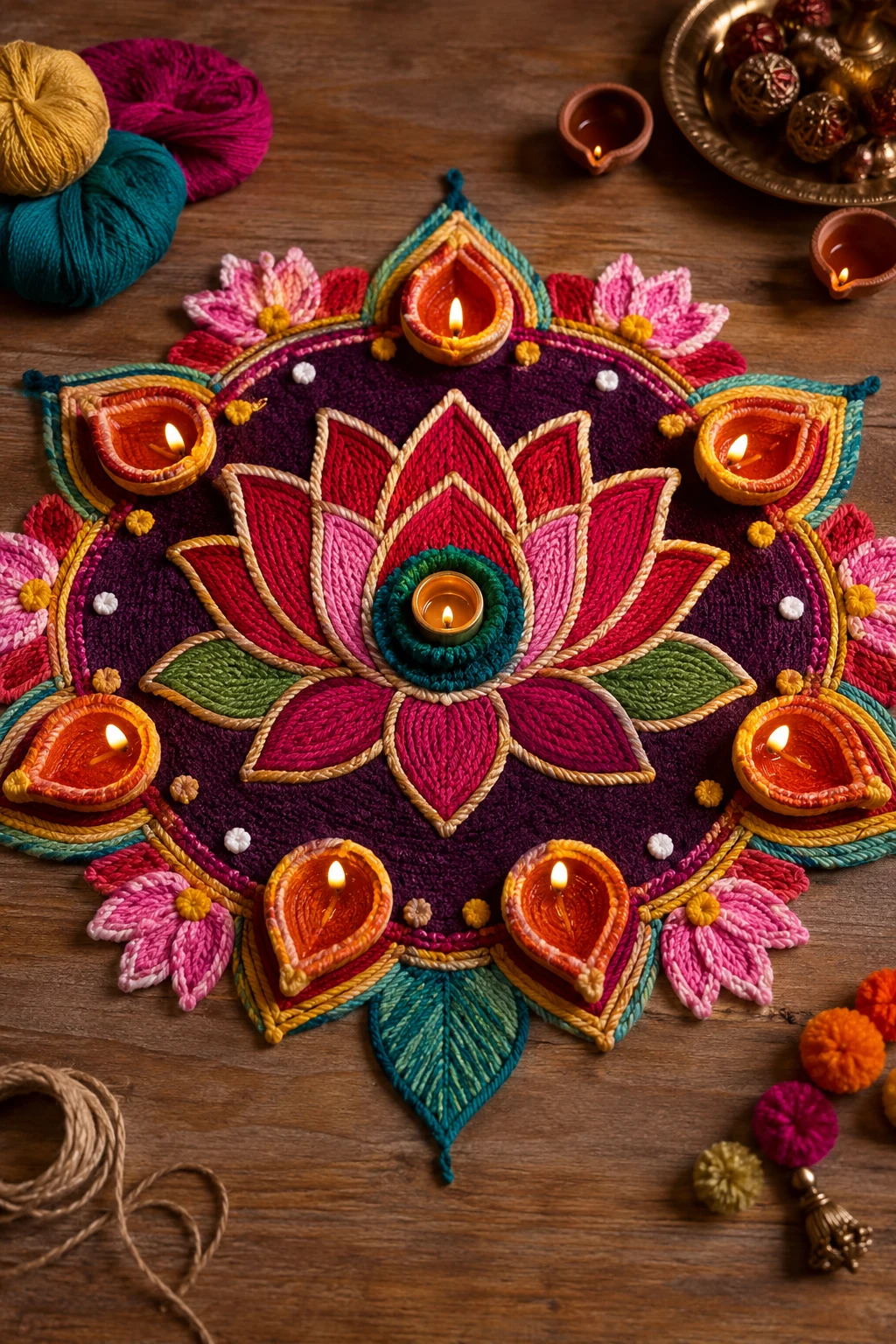
13. Lotus and Diya Festival Centerpiece
Combine two classic motifs by placing a lotus in the center and four diyas around it. Surround the arrangement with a ring of dots, leaves, and tiny flowers for a compact festival centerpiece.
Pink lotus petals, golden-yellow centers, orange flames, and green leaves create a traditional color story. Add decorative diyas around the perimeter after the powder design is finished for extra Diwali atmosphere.
The key to this look is giving the lotus visual priority and using the diyas as supporting elements rather than competing with the centerpiece.
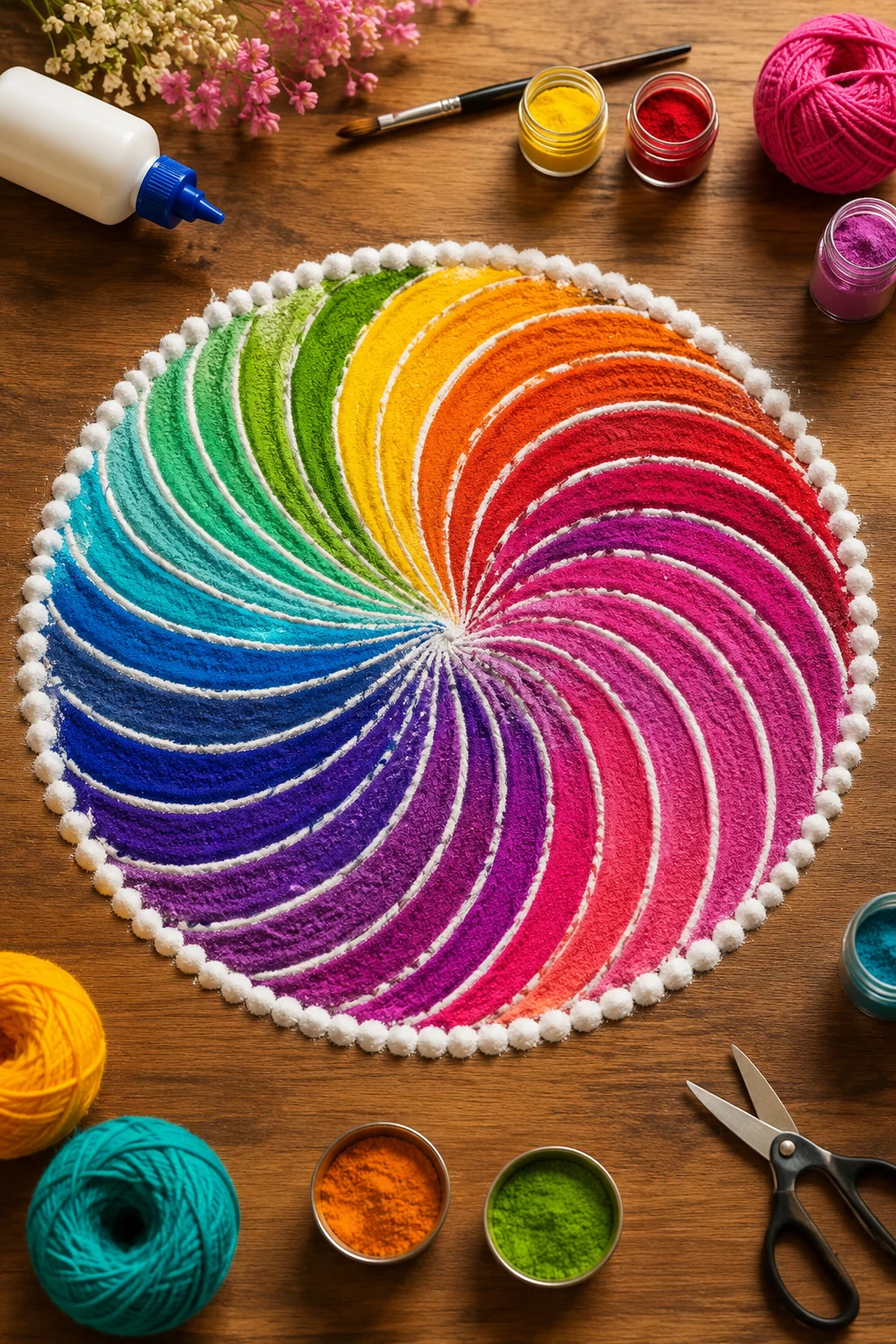
14. Rainbow Spiral
If traditional symmetry is starting to feel a little too serious, make a spiral. Begin in the center and draw a continuous curved line outward, creating several spiral arms. Fill each section with a different color.
The key to this technique is maintaining a steady spiral direction while leaving enough space between lines for clean color application.
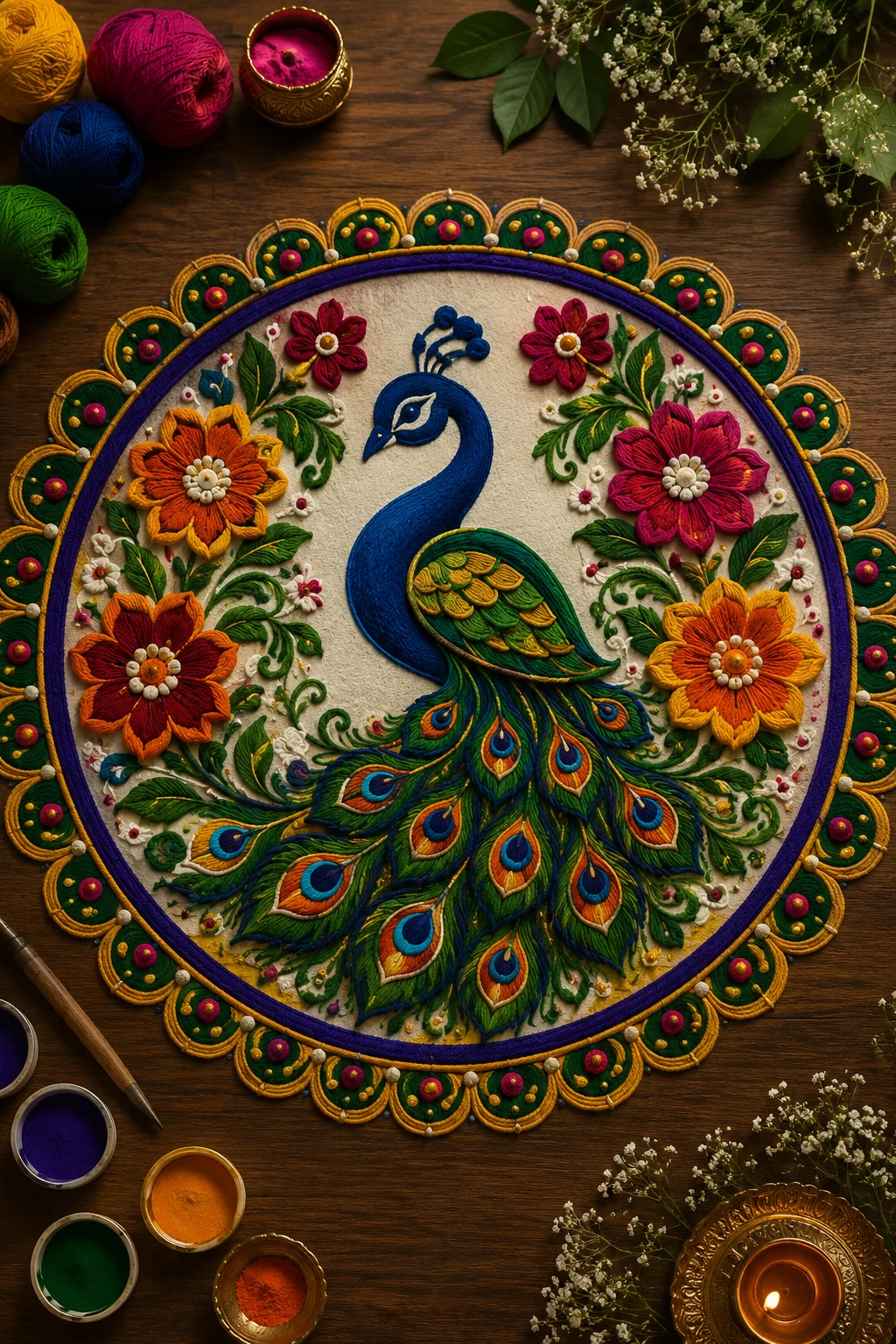
15. Grand Floral Peacock Circle
For the grand finale, combine the best features of several indian rangoli designs: a peacock centerpiece, lotus petals, smaller flowers, leafy vines, dots, and a broad circular border. This is the design to save for Diwali, Pongal, weddings, housewarming celebrations, or a rangoli competition.
Begin with the peacock, then work outward one ring at a time. Use rangoli powder applicator bottles, small bowls of color, and a fine white powder for outlining. A current practical trend in festive floor art is mixing traditional motifs with brighter jewel-tone palettes, making emerald, cobalt, fuchsia, and saffron a particularly striking combination.
The key to this look is building the design from the center outward, allowing each decorative ring to support the next instead of improvising the entire composition at once.
FAQ
What are indian rangoli designs?
Indian rangoli designs are decorative patterns traditionally created on floors using colored powders, rice, flowers, or other materials. They are commonly made for Diwali, Pongal, weddings, religious celebrations, and everyday entrance decoration.
How do I make indian rangoli designs at home?
Start with a simple circle, flower, dot grid, or geometric outline, then fill each section with rangoli powder. For beginners, indian rangoli designs simple patterns with dots or large petals are easier to control than highly detailed compositions.
Why are indian rangoli designs popular for Diwali?
Rangoli adds color and decoration to entrances and living spaces during Diwali while traditional motifs such as diyas, lotus flowers, peacocks, and geometric patterns create a festive welcome.
📚 You Might Also Like
- Free hand rangoli designs with colours: 15 Easy DIY
15 Free Hand Rangoli Designs With Colours for Beautiful DIY Decor Free hand rangoli designs with col…
The Bottom Line
The best thing about indian rangoli designs is that there is no single “correct” way to make them. You can choose dots, flowers, peacocks, diyas, geometric borders, or a completely freehand pattern and build your own color story. Start small if you are new to rangoli, then experiment with larger circles and layered motifs as your confidence grows. Keep rangoli powder, a few simple tools, and contrasting colors nearby, and let the design evolve. Perfect symmetry is nice; having fun and keeping the floor colorful is even better.
🛍️ Shop the Look — indian rangoli designs
Our handpicked Amazon picks curated specifically for indian rangoli designs:
As an Amazon Associate I earn from qualifying purchases.